EventTech — corporate event operations on Quarkus#
Note
A real client brief, built by an agent with Specgate. The brief came from a real client; the product was built end to end by a coding agent (Claude) driving Specgate, with business decisions delegated to it and written down as assumptions. It is not a customer deployment, and the code repository is private.
This is agent-driven adoption, not a customer story. It was the first pilot on Quarkus, and the first to use rule D12 the day it shipped.
| Brief | Architecture-heavy: event sourcing, CQRS, change data capture |
| Stack | Quarkus 3.40 · Java 21 · Maven · PostgreSQL (Dev Services) · WebSocket · ArchUnit |
| Requirements | 38 of 38 |
| Tests | 71 |
| Specgate | 0.17.9 |
The brief#
Operations for corporate events: parallel sessions, speakers, registration, catering by dietary restriction, transport, hotels, badges, live room occupancy and reports. Like FinCore, it came with a lot of architecture — EventStoreDB, CQRS, Debezium.
The infrastructure was set aside, but what it promises was kept as functional requirements: rebuild the event as it was at any time ("the agenda on any date", "when did the room fill up?"), live updates, and reports.
How Specgate was used#
Adopt once
bash specgate init --no-capabilities specgate config set test_cmd "./mvnw -q -B verify" specgate ci init --provider github # setup-java 21, Maven cache, specgate checkOne draft per module
bash specgate change new draft-eventos --capability eventos --reserve <n> specgate draft --check draft-eventosD12 found a real gap in the first draft: the organizer could not see the sessions of an event still in draft. From then on, every draft said where each id comes from from the start.
Archive, test, close
bash specgate change archive draft-eventos specgate done REQ-047 specgate check
Five drafts, one per module, and one follow-up change (informes-2).
@QuarkusTest starts the whole application, so the lesson from FinCore —
an app that does not start while every test is green — came built in: a
startup test was there from the first commit.
What was built#
| Module | Requirements | Notes |
|---|---|---|
| Events | 11 | Event sourcing on Postgres: an insert-only JSONB fact table; the agenda at any date |
| Registration | 8 + REQ-008 MODIFIED | Capacity and seats decided in one aggregate; concurrency tested; waiting list |
| Logistics | 8 | Catering adjustments computed as current order minus sent, nothing stored |
| Access | 6 | HMAC badges; live occupancy over WebSocket, sent only after commit |
| Reports | 4 + REQ-047 MODIFIED | Everything rebuilt from the facts |
| Adoption baseline | 1 | REQ-001 |
Two requirements were MODIFIED. Archiving regenerated each feature file and sent the requirement back to Draft until its new scenario passed.
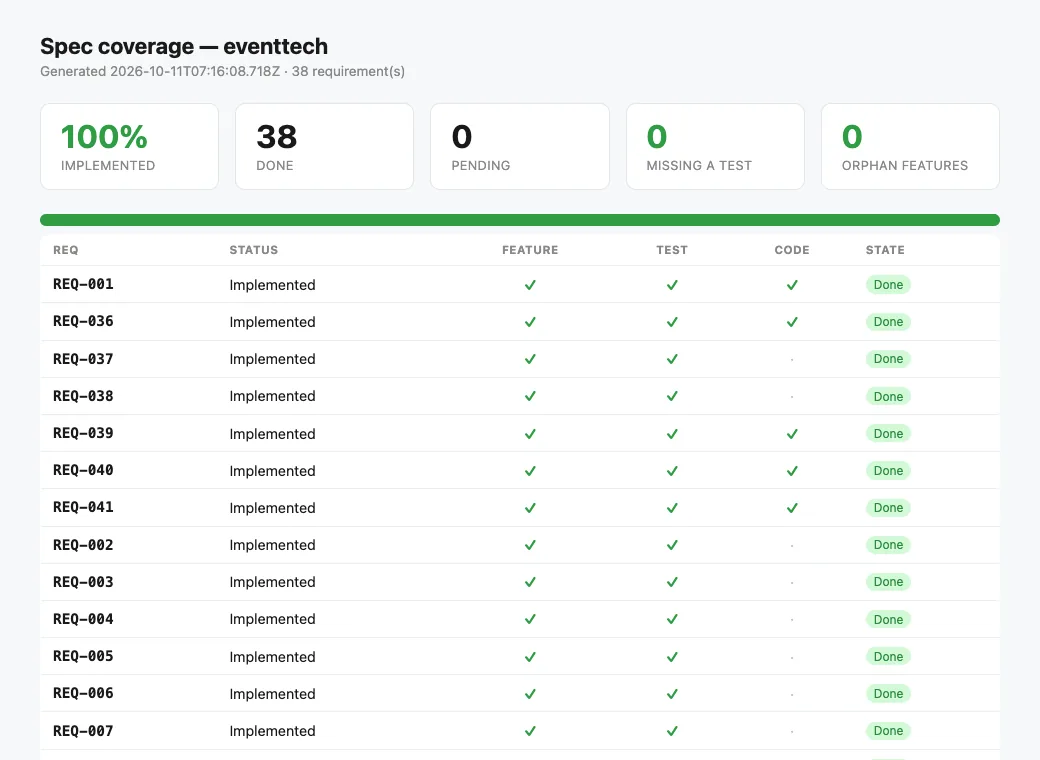
specgate report for this project, generated from its matrix at the end of the pilot.
What only running the product found#
| Gap | How it was closed |
|---|---|
| A badly written date returned 400 with no body | A test and an error mapping for the JSON parser |
| A session could be moved to a smaller room | REQ-008 MODIFIED |
| Nobody could see a session's free seats | REQ-041 added |
| Entries without a booking were invisible; no-shows counted for sessions still to come | REQ-047 MODIFIED (informes-2) |
The rule from the three pilots before holds: the gate verifies what the specification says; using the application finds what it does not say.
What Specgate got wrong, and what changed#
| Finding | Fixed in |
|---|---|
#80 — D12 flagged actions whose id the actor gets through a nested list (GET /api/eventos/{id}/sesiones for POST /api/sesiones/{id}/…); three drafts had to declare it as an assumption | 0.17.10 |
| #81 — a MODIFIED requirement went through D12 again without seeing the assumption from its archived draft | 0.17.10 |
Quarkus needed no adaptation: Specgate detected it and ./mvnw, the
generated CI installed Java 21, and Dev Services ran in GitHub Actions.
Still open#
- No question waits for an answer. All 38 requirements are implemented.
- The infrastructure in the brief — EventStoreDB, change data capture to marketing and CRM tools, video conferencing, payments, real NFC readers — is out of scope. Each has a port ready for it.