Credit shop — an online store with credit and a sales network#
Note
A real client brief, built by an agent with Specgate. The brief came from a real client; the product was built end to end by a coding agent (Claude) driving Specgate, with business decisions delegated to it and written down as assumptions. It is not a customer deployment, and the code repository is private.
This is agent-driven adoption, not a customer story. It is the opposite of Bookings: a brief with almost nothing in it, where the draft had to invent nearly every value and the checklist had to make that visible.
| Brief | Vague: five lines, no values, rules or screens |
| Stack | Next.js + a hexagonal TypeScript core (packages/core) |
| Requirements | 24 of 24 |
| Tests | 272 test cases in the repository |
| Specgate | 0.17.2 → 0.17.5 |
The brief#
One paragraph: an application that manages credit, online sales and a network of sellers. A catalog and a cart, credit applications, commissions and performance for the sellers. It should be "scalable, secure and easy to use". Not one price, limit, rule or screen.
How Specgate was used#
One draft per module
bash specgate change new draft-tienda --capability tienda --reserve <n> specgate draft --check draft-tienda # then draft-credito, draft-redThe draft rule D8 caps a draft at 25 requirements, so the MVP was cut into three: store (9 requirements), credit (7), sales network (6).
Turn every finding into an assumption or a question
D6 flagged 50, 36 and 23 invented values in the three drafts, covered in the end by 6, 5 and 5 written assumptions. Two questions blocked a requirement: who pays for shipping, and who finances the credit. Those requirements went in as
Needs Clarification.Archive and build
bash specgate change archive draft-tienda specgate harness runAnswer the questions as a change
The answers went in as a change named
respuestas, with REQ-008 and REQ-016 MODIFIED. Then the harness built them.
The harness built 20 of 20 buildable requirements, 15 on the first attempt. It refused the two blocked ones in about a second, without calling the agent: "status is Needs Clarification — an agent asked to settle a disagreement will settle it by guessing."
What was built#
| Module | Requirements | Notes |
|---|---|---|
| Store | 10 | Catalog, cart, orders, shipping; REQ-027 adds a menu per role |
| Credit | 7 | Application, pre-contract information, approval, online contract |
| Sales network | 6 | Sellers, referral links, commissions, settlement, performance |
| Adoption baseline | 1 | REQ-001 |
REQ-012 (information before credit) cites the Spanish consumer-credit law with its source, and D5 checks that it does. The numbers were computed before they were written into scenarios: 1,200 € over 12 months at 12 % nominal gives a monthly payment of 106.62 €, an APR of 12.68 % and a total of 1,279.44 €.
The answers decided: shipping is 4.95 € below 50 €, and the store finances
the credit, with the contract accepted online. The product reached v0.1.0.
What only running the product found#
With every test green, nobody could buy anything.
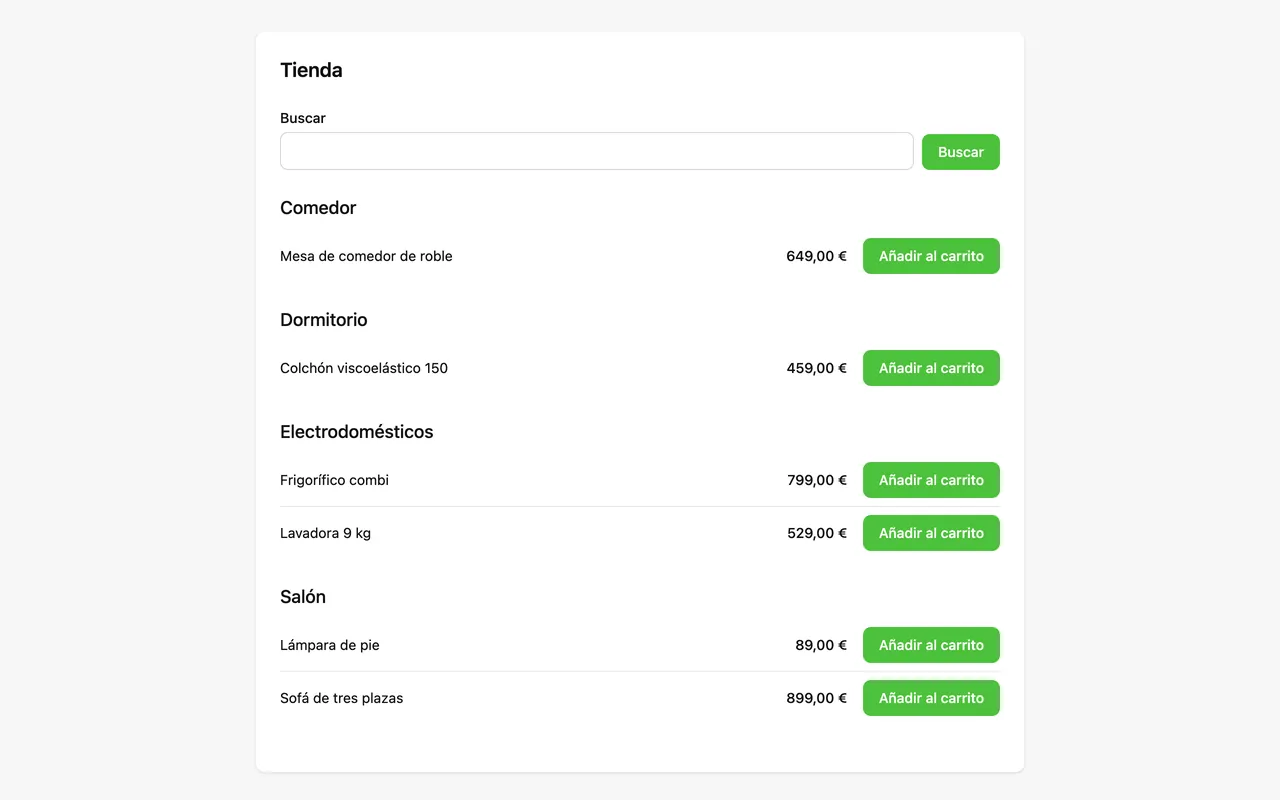
- The store had no "Add to cart" button. REQ-005 had an API scenario for adding and a screen scenario for changing the quantity. The agent built exactly that.
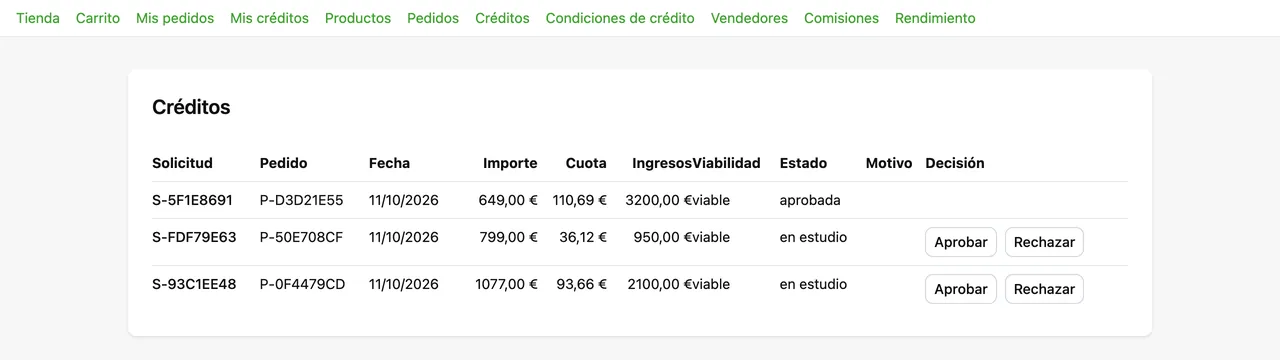
- No screen had a menu. The administrator's panel said "Hello" and nothing else.
- Prices with a decimal comma could not be typed into a number field in an English-language browser.
It is the same pattern as the photos in Bookings: an action with an API scenario and no screen scenario is not built on screen. D3 does not see it, because the requirement does have a screen scenario.
A follow-up change, tienda-2, MODIFIED REQ-005 and added REQ-027. The
second smoke test walked the whole journey without touching code: a customer
arrives through a seller's link, buys, asks for credit, the administrator
approves, the customer signs, the order is delivered, the seller's
commission is settled, and the performance view shows it.
What Specgate got wrong, and what changed#
| Finding | Fixed in |
|---|---|
#59 — validate --strict failed on the two Needs Clarification requirements: the gate punished the draft for asking instead of guessing | 0.17.3 |
#60 — init proposed three requirements on a fresh skeleton (third time across pilots) | 0.17.4 |
#65 — the harness lost attempts on REQ-011, REQ-017 and REQ-018 because done reordered the trace; twice the agent then tried to edit the matrix by hand, and write-scope stopped it | 0.17.5 |
| #66 — a hung agent ran 53 minutes against a 20-minute limit | 0.17.5 |
| #76 — an action on an id the actor has no way to get (seen here and in Bookings first) | 0.17.9 (D12) |
With 0.17.5, the two tienda-2 requirements passed on the first attempt
with no write-scope losses.
Still open#
- An API action with no screen scenario (D11). A rule is reserved, not built: matching each API scenario to its screen scenario is not mechanical, and a rule by count gave false positives on this pilot's drafts and Bookings' (#83). Running the product stays the safety net.
- Minor noise. D6 reads the "500" in a product URL as a value.
- No question waits for an answer. Both were answered and built.