Bookings — appointments for local businesses#
Note
A real client brief, built by an agent with Specgate. The brief came from a real client; the product was built end to end by a coding agent (Claude) driving Specgate, with business decisions delegated to it and written down as assumptions. It is not a customer deployment, and the code repository is private.
This is agent-driven adoption, not a customer story. It was the first product
to go through specgate draft --check, and it ran in five cycles, each one a
short draft followed by a test of the running product.
| Brief | Detailed: a short document with 15 screenshots of other products |
| Stack | Next.js + a hexagonal TypeScript core (packages/core), web only |
| Requirements | 38 of 38 |
| Tests | 212 test cases in the repository (118 after the first cycle) |
| Specgate | 0.16.0 → 0.17.4 |
The brief#
A booking system for local businesses such as hair salons and beauty parlours. Each business gets a small public page, several calendars with slots per hour, coupons (public and private), and online booking settings. After an appointment, the customer is asked for feedback, and good ratings lead to the business's Google Maps page. The brief also asked for push reminders and a widget for the business's own website. Part of the text was copied from another product, and the integration section was empty.
How Specgate was used#
The brief went into docs/brief.md unchanged, with a front matter naming the
actors and their surfaces, and a description of what each screenshot shows.
Draft the first module as a change
bash specgate change new draft-reservas --capability reservas --reserve <n> specgate draft --check draft-reservas18 requirements and 34 scenarios, with an API and a screen scenario for each thing a person does. The first check returned 75 findings.
Write the assumptions, answer the question
13 assumptions in
assumptions.md(blocked hours, status codes, a minimum width, no online payment, booking without an account). One question inquestions.md— cancellation — was the only one that blocked anything.Archive, adopt, build
bash specgate change archive draft-reservas specgate init specgate harness init specgate harness run # one requirement, one PR to developRepeat per module
Four more cycles, each a draft, a check, an archive and a harness run: the owner's panel, coupons, feedback after the visit, and the public page.
The first harness run built 18 of 18 requirements, 17 on the first attempt. The agent took 99–378 seconds per requirement (median 210). Every later cycle built all its requirements, all on the first attempt except where a Specgate defect cost one (#56, #65).
What was built#
| Module | Requirements | Notes |
|---|---|---|
| Business, calendars, services | 6 | A business, its calendars, services with duration and price |
| Bookings | 7 | Book without an account, cancel with a link, the owner's agenda |
| Settings | 5 | Online booking rules |
| Panel | 2 | A menu on every owner screen, the public link (cycle 2) |
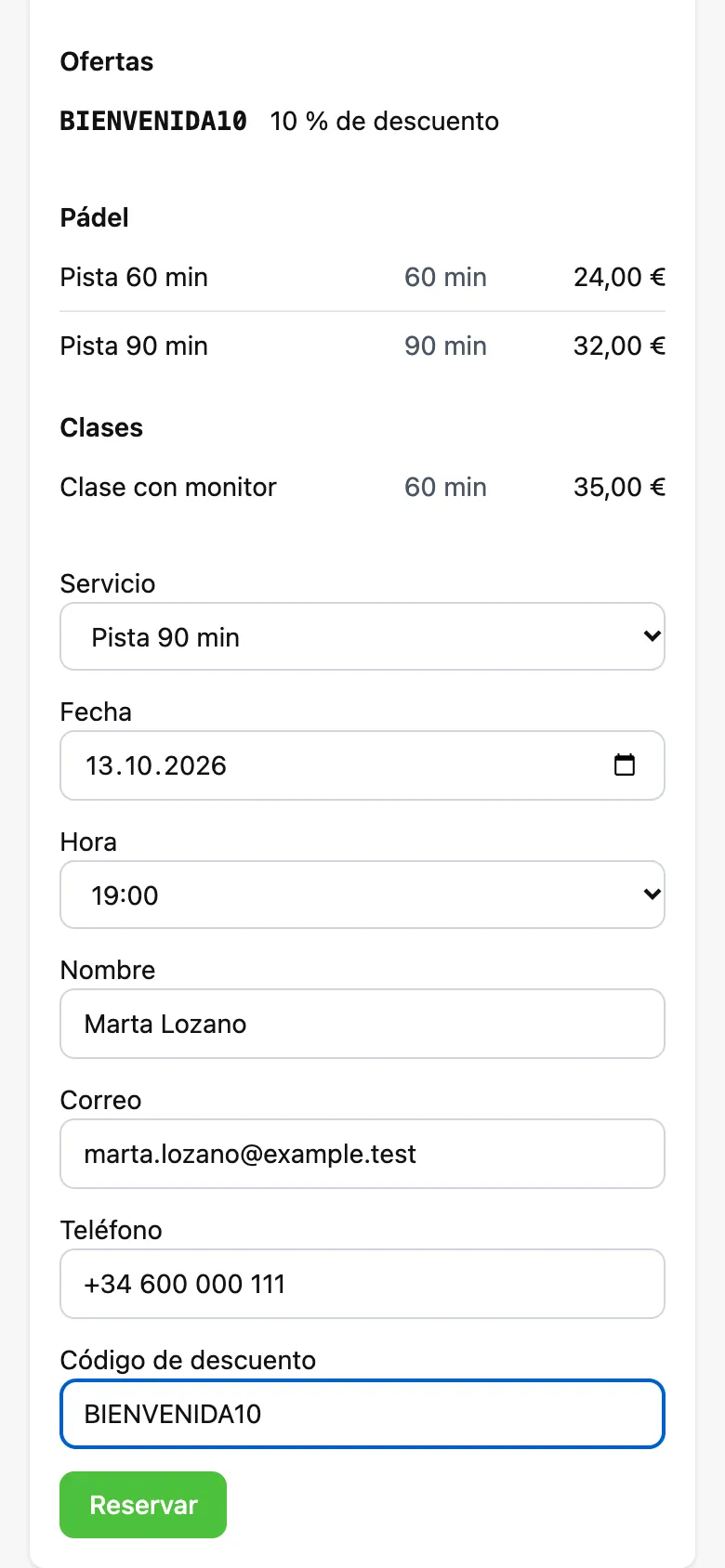
| Coupons | 5 | Public and private, applied when booking, visible in the agenda |
| Feedback | 5 | One survey by email, rating 1–5, 4–5 sent to the Google Maps link |
| Public page | 7 | Details, photos, map, public reviews, city directory, subdomain |
| Adoption baseline | 1 | REQ-001 |
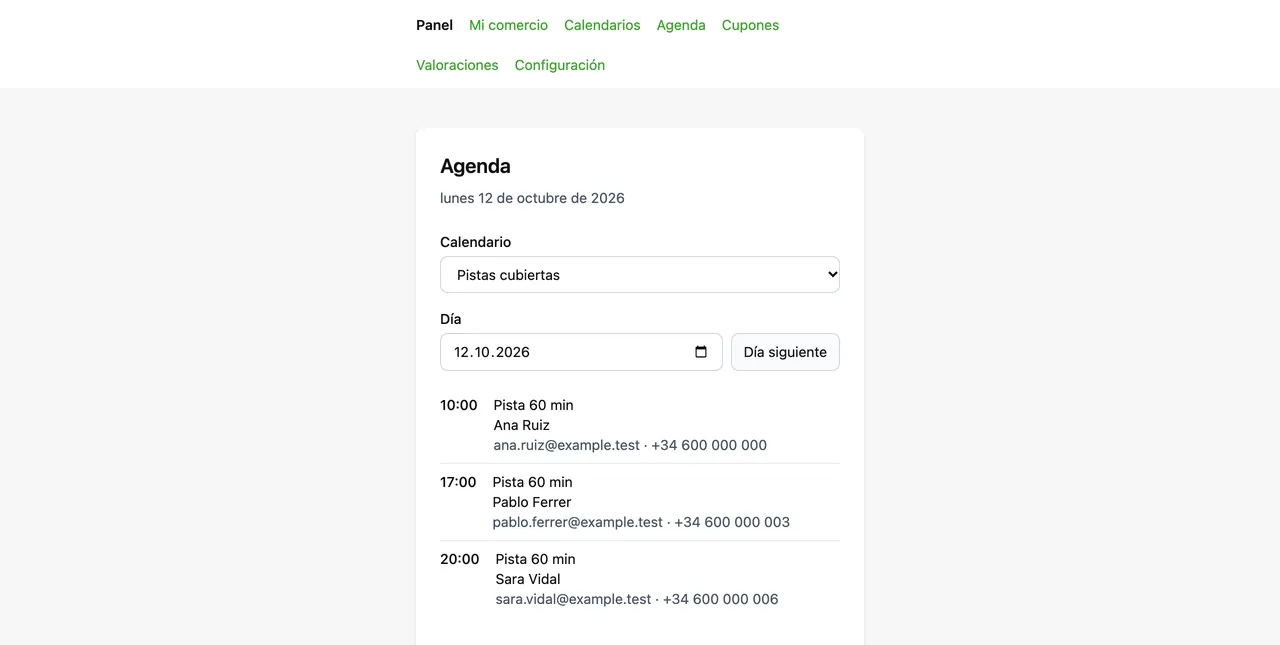
Requirement REQ-145 (the agenda) and REQ-220/221 (details and photos) were
MODIFIED after a smoke test. The product reached v0.3.0.
What only running the product found#
Each cycle ended with the product running in production mode and a person — or headless Chrome — using it end to end. The first walk-through worked: an owner set up a business and a slot, a customer booked at 360 px wide and cancelled with the link. The gaps were elsewhere:
- The agenda showed only today. The scenario said "sees today's bookings", and the API accepted any day. Fixed by MODIFIED REQ-145.
- No menu, and no way to find the public page address. Fixed by REQ-200 and REQ-201. In the next cycle the agent added "Coupons" to the menu unasked, reading REQ-200 as a standing rule.
- The survey job was open to anyone until a secret was set. Now always protected.
developdid not build for production. Aneslint-disablefor a rule that was not loaded passed typecheck and tests (#62).- The owner had no screen for their details or photos, and the public page did not show the photos. "Show them on the public page" was in the requirement text with no scenario to prove it, so it was not built. What has no scenario does not exist.
Some gaps stay as written, because the specification says so: a 30-minute service is offered only on the hour (assumption A3, hourly slots).
What Specgate got wrong, and what changed#
The defect log has 22 entries from this pilot, plus #60, which three pilots hit.
| Finding | Fixed in |
|---|---|
| #42 — D4 flagged "responsive … from 360 px" as unmeasured | 0.17.1 |
| #43 — D6 reported a repeated value twice | 0.17.1 |
#44 — init named a test command that check then said was missing | 0.17.1 |
| #45 — D7 could not see an answered question | 0.17.1 |
| #46 — archiving a green draft wrote no feature files | 0.17.1 |
| #47 — Spanish scenarios became invalid Gherkin | 0.17.1 |
#48 — status listed archived requirements without titles | 0.17.1 |
| #49 — a green draft failed the harness on two-word scenario titles | 0.17.1 |
| #50 — the harness retried three times on failures the agent cannot fix | 0.17.1 |
| #51 — D3 asked a screen-only menu for an API scenario | 0.17.2 |
| #52 — D6 flagged values already reviewed in an earlier draft | 0.17.2 |
| #53 — a MODIFIED requirement kept its old feature file | 0.17.2 |
| #54 — "Ready to close" with two scenarios untested | 0.17.2 |
| #55 — a draft reused scenario ids from another module | 0.17.3 |
#56 — the harness prompt said done, and write-scope punished it | 0.17.3 |
#60 — init proposed three requirements on a fresh skeleton | 0.17.4 |
| #61 — D3 accepted a customer's screen as the owner's | 0.17.4 |
| #62 — the gate did not include the production build | 0.17.4 |
| #63 — the harness read a missing test as a fault in the specification | 0.17.4 |
| #64 — two MODIFIED requirements blocked each other's gate | 0.17.4 |
#65 — done reordered the trace, and write-scope rejected it | 0.17.5 |
| #57, #58 — a draft could be archived with findings still open | 0.17.10 |
Two frictions were never logged as defects: plan orders by capability name,
not by dependency, so the build order was given by hand; and D6 has no way to
declare a convention (status codes, labels) once.
Still open#
- The rest of the brief. Push reminders 24 hours before, and the integration section (a widget for the business's website). Not drafted.
- No question waits for an answer. The one that blocked something, cancellation, was answered during the review of the first draft.